
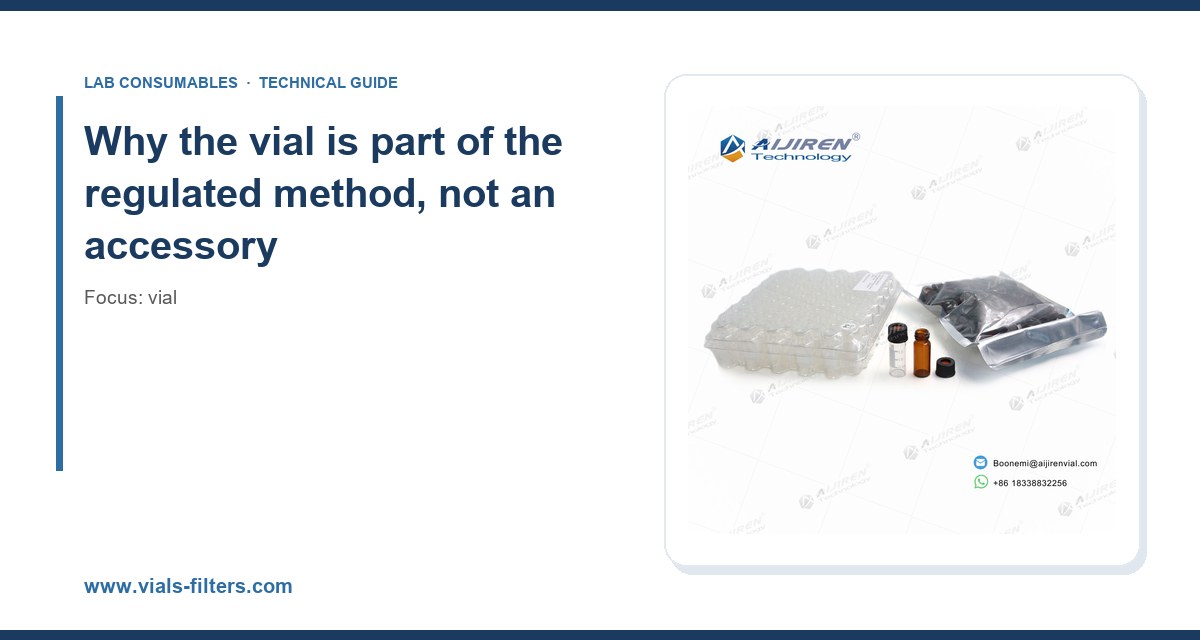
About eight years ago I watched a lab fail an EPA Method 8260 audit over something that cost less than a dollar: the wrong vial. The method blanks were clean, the calibration curve was tight, but the reviewer flagged that the lab had no documented lot traceability on the 40 mL VOC vials and could not show that the septa met the method’s inertness requirements. The rework took three weeks. I have treated vial selection as a regulated-method decision ever since, not a purchasing commodity.
If your data ends up in a regulatory submission, a permit application, a consent decree, or a court case, the vial is part of the analytical system. It has a specification, a failure mode, and a documented role in the method. Below is how I think through vial selection and control for EPA, ISO, and AOAC work, with the numbers that actually matter.
Regulated methods are written around the sample container. EPA SW-846 Method 5030 (purge and purge-and-trap) and Method 5035 (closed-system purge-and-trap for solids) specify the container, the headspace, and the preservation. Method 8260 and 8270 depend on those sample containers delivering an unaltered analyte list to the instrument. If the vial adsorbs, leaches, or leaks, the method is out of control even when every instrument parameter is nominal.
ISO methods take the same position from the other direction. ISO 5667-3 governs sample preservation and handling, and it is explicit that the container material must not sorb or release analytes. ISO 17025 accreditation then requires that you can demonstrate the container met its specification. That means a certificate of analysis, a lot number, and a record that ties the lot to the samples it held.
AOAC methods carry the same burden through the Official Methods of Analysis program. AOAC 2007.01 (pesticide residues in foods by acetonitrile extraction) and the QuEChERS family specify centrifuge tubes and autosampler vials with defined volumes and closure types. The AOAC process expects you to use containers that meet the method’s stated geometry, and to document it.
The practical consequence: treat the vial, septum, and cap as a single qualified part number. Do not mix lots. Do not substitute a “close enough” vial mid-run. I have seen a lab switch from a 9 mm screw-thread vial to a 11 mm crimp vial mid-sequence because of a stockout, and the resulting retention time drift on early-eluting compounds triggered a full re-extraction.
EPA SW-846: what the methods actually demand from the container
SW-846 is the EPA’s test methods manual for evaluating solid waste. It is not a single document; it is a collection, and the container requirements vary by method. The U.S. EPA SW-846 test methods for waste and materials page is the authoritative index, and I keep a printed copy of the container-relevant sections in the lab.
Volatile organics: 40 mL VOA vials and the headspace rule
Methods 5030 and 5035 require a 40 mL volatile organic analysis (VOA) vial with a PTFE-lined septum and a solid cap. The critical number is headspace. Method 5030 allows zero headspace for aqueous samples; Method 5035 for solids requires the sample to be collected in a sealed, zero-headspace container, often a 40 mL vial pre-weighed with a preservative. If you leave more than a bubble the size of a pea, the method is compromised for the lightest compounds.
I specify 40 mL clear or amber borosilicate vials, 24 mm neck, 22 mm PTFE-faced silicone septum, open-top screw cap. The septum matters more than the glass. A silicone-backed PTFE septum gives you the inertness of PTFE on the sample side and the resealability of silicone on the needle side. A plain silicone septum will leach siloxanes and produce false positives on the GC/MS scan for compounds like octamethylcyclotetrasiloxane.
Torque on the 24 mm cap is a real number. I hand-tighten to roughly 1.5 to 2.0 N·m with a calibrated torque wrench when the lab is doing a lot release. Over-torque deforms the PTFE face and creates a channel leak. Under-torque lets the septum lift under autosampler needle pressure. A 24 mm cap torqued past about 2.5 N·m will often show a visible crease in the PTFE after a week.
Semi-volatiles and the amber glass question
Method 8270 semi-volatiles are less sensitive to headspace but more sensitive to light and adsorption. Amber glass is standard for extracts and for storage of standards. The amber coating is a surface treatment, not a dye in the glass, and it can be degraded by harsh cleaning. I do not re-use amber vials for regulated work; the coating integrity is not documented after cleaning.
Cleanup and the reagent bottle
Method 3620 (Florisil cleanup) and Method 3660 (sulfur cleanup) use reagent volumes that come out of a reagent bottle. The bottle has to be borosilicate with a GL 45 or GL 32 screw thread per the ISO 4796 glassware family, and the cap liner has to be PTFE for solvent compatibility. I have seen labs use a bottle with a polyethylene liner for methylene chloride; the liner swells, the cap cracks, and the solvent evaporates over a weekend.
ISO methods: preservation, traceability, and the accreditation trail
ISO work is less prescriptive about the exact vial and more demanding about the evidence. ISO 5667-3 sets the preservation and handling rules; ISO 17025 sets the quality system. Together they mean you need a container specification, a supplier qualification record, and a lot-level certificate of analysis.
What a vial certificate of analysis should contain
I reject supplier CoAs that list only “borosilicate glass.” A usable CoA for regulated work includes:
- Glass lot number and glass type (borosilicate 3.3, expansion coefficient 3.3 × 10⁻⁶ /K)
- Septum lot and compound (PTFE-faced silicone, durometer, thickness in mm)
- Dimensional check (neck OD, height, septum diameter within tolerance)
- Extractable screening (a blank run by GC/MS or LC/MS with a stated detection limit)
- Cap torque or seal test result if the supplier offers it
The extractable screening is the one auditors ask about. A supplier that runs a 40 mL vial blank through a 8260 scan and reports “no target analytes above 5 ppb” is giving you something you can file. A supplier that says “chemically inert” is giving you a marketing sentence.
Autosampler vials and the 2 mL standard
The 2 mL autosampler vial is the workhorse for HPLC and LC/MS work under ISO and AOAC methods. The governing geometry is a 12 × 32 mm vial with a 9 mm screw thread or an 11 mm crimp neck. The vial you pick has to match the autosampler tray, and the septum has to survive the injection count. A silicone/PTFE septum is good for roughly 3 to 5 punctures before the reseal starts to fail; a pre-slit septum pushes that to about 10 but increases evaporation on long sequences. For a 96-injection overnight run, use a fresh vial per 6 to 8 injections or accept a small drift.
For HPLC work I link the vial choice to the column and detector. If you are running a modern sub-2 µm column on a UHPLC, the injection volume is small and the vial dead volume matters. A 300 µL insert in a 2 mL vial reduces the sample volume needed but adds a transfer step that can introduce air. I usually go with a 1.5 mL fill in a 2 mL vial and a 9 mm screw cap for routine work. The Agilent chromatography consumables and columns catalog is a good cross-reference for autosampler compatibility, and Thermo Fisher chromatography and sample handling publishes similar compatibility tables for its autosamplers.
AOAC methods: food and agricultural matrices
AOAC methods add a matrix dimension that EPA methods mostly avoid. Food and feed samples carry fats, proteins, and pigments that foul septa and adsorb onto glass. The QuEChERS workflow (AOAC 2007.01) uses a 50 mL centrifuge tube for extraction and a 2 mL autosampler vial for the final extract. The vial has to be clean enough that a pesticide at 10 ppb is not lost to the glass.
My rule for AOAC work: use deactivated glass for anything that will hold a polar or semi-polar analyte. A silanized (deactivated) 2 mL vial costs more than an untreated one, but it prevents the tailing and low recovery that show up on compounds like methamidophos or acephate. The deactivation is a surface treatment; it does not survive aggressive cleaning, so treat these as single-use.
Headspace and GC vials in AOAC and EPA work
Headspace analysis is where vial selection gets technical. A headspace vial for a GC headspace autosampler is typically 20 mL with a 20 mm crimp neck and a PTFE/silicone septum. The crimp has to be uniform; a poorly crimped cap leaks and the headspace equilibrates with the lab air. I check crimp height with a gauge and reject caps that are more than 0.2 mm off nominal. The septum for headspace is usually a thicker silicone layer (about 1.5 mm) with a PTFE face, because the autosampler needle is larger and the vial is heated to 60 to 90 °C for equilibration.
For direct-injection GC work, the GC vial is usually the same 2 mL autosampler vial but with a septum chosen for the injection port temperature. A standard silicone/PTFE septum is rated to about 200 °C; if your inlet is at 250 °C or above, use a high-temperature septum or accept a bleed peak. I have seen a lab chase a phantom siloxane peak for a week before realizing the septum was the source.
Selection criteria with numbers
Here is the decision table I use when a lab asks me to specify vials for a regulated method. The numbers are the ones I have validated or seen validated; treat them as starting points, not gospel.
Comparison checklist: vial type by method family
- EPA 5030/5035 volatile organics: 40 mL VOA vial, 24 mm neck, PTFE/silicone septum, zero headspace, cap torque 1.5–2.0 N·m, single-use, lot traceability required.
- EPA 8270 semi-volatiles: 40 mL or 1 L amber glass, PTFE-lined cap, no headspace for extracts, store at 4 °C, hold time 40 days from extraction.
- EPA 8260 GC/MS: 40 mL VOA vial, septum screened for siloxane background, blank run per lot, needle puncture count 1 per injection, replace vial after 3 punctures.
- ISO 5667-3 water sampling: borosilicate or HDPE depending on analyte, PTFE-lined cap, documented preservation (HNO₃ for metals, H₂SO₄ for nutrients), hold times per the standard.
- AOAC 2007.01 QuEChERS: 50 mL centrifuge tube for extraction, 2 mL deactivated autosampler vial for final extract, 9 mm screw cap, septum puncture limit 5.
- Headspace GC (EPA 5021, AOAC): 20 mL headspace vial, 20 mm crimp, 1.5 mm PTFE/silicone septum, crimp height within 0.2 mm, equilibration 60–90 °C.
- HPLC/UHPLC: 2 mL vial, 12 × 32 mm, 9 mm screw or 11 mm crimp, fill 1.5 mL, septum puncture limit 5–8, insert only if sample volume is limited.
Temperature and pressure ratings that matter
Borosilicate 3.3 glass handles the thermal cycling in a headspace oven without issue. The failure point is the septum and the cap, not the glass. A standard PTFE/silicone septum is rated to about 200 °C continuous; a high-temperature silicone septum goes to 250 °C. The cap material matters too: a polypropylene cap softens around 120 °C, so for headspace work above that you need a metal crimp cap or a high-temperature polymer. I have seen a polypropylene screw cap deform in a 150 °C headspace oven and release the septum, which ruined a batch of 40 samples.
Operational precautions that prevent rework
Most vial failures I have investigated were not material failures. They were handling failures. The list below is the one I put on the wall of the sample prep room.
- Never re-use a septum. The puncture count is cumulative and the reseal degrades. A septum that has been punctured 6 times will leak on the 7th.
- Check headspace on VOA vials by inversion. A bubble larger than a pea on a 40 mL vial is a reject. I have seen a lab accept a 3 mm bubble and lose the lightest compounds on the 8260 list.
- Torque caps with a gauge, not by feel. 1.5–2.0 N·m for 24 mm caps; 0.8–1.2 N·m for 9 mm screw caps. Over-torque is the more common error.
- Store standards in amber glass with a PTFE-lined cap. A polyethylene liner will adsorb semi-volatiles over a week.
- Run a vial blank per lot. Fill a clean vial with the method’s blank matrix, run it through the full sequence, and file the chromatogram. This is the single cheapest audit defense you have.
- Keep the lot number on the bench sheet. If the CoA says lot 24A, the bench sheet says lot 24A. An auditor will ask.
Troubleshooting checklist
When a regulated run goes out of control and the instrument looks fine, I work through this list in order. It is faster than re-running the batch.
Symptom: low recovery on volatile compounds
Check headspace first. Then check septum integrity (a punctured septum that has been re-used). Then check cap torque. A 40 mL vial with a 0.5 N·m cap will lose about 10 to 15 percent of the lightest compounds over 24 hours at 4 °C. If all three are nominal, run a vial blank to rule out adsorption on a new glass lot.
Symptom: phantom peaks on GC/MS
Look at the septum. Silicone septa bleed siloxanes; the classic ions are m/z 73, 207, and 281. If the phantom peak appears only on vials that have been heated, the septum is the source. Switch to a PTFE-faced septum or a high-temperature septum and re-run the blank. I also check the inlet liner and the gold seal, but the septum is the first suspect.
Symptom: retention time drift across a sequence
Check the vial fill volume and the septum puncture count. A vial that has been punctured 10 times loses volume to evaporation and the injection volume changes. For a 96-injection run, split the sequence across fresh vials every 6 to 8 injections. Also check that the autosampler needle is not coring the septum; a dull needle punches a plug that falls into the vial.
Symptom: audit finding on traceability
This is a records problem, not a chemistry problem. Reconstruct the lot numbers from the supplier CoAs and the bench sheets. If the bench sheet does not have the lot number, the finding stands. The fix is procedural: add the vial lot to the bench sheet template and require the CoA to be filed with the run.
Recommendation
For a lab running EPA, ISO, and AOAC methods, I recommend a single qualified vial platform per method family, with a documented CoA and a lot-level blank. Concretely: 40 mL borosilicate VOA vials, 24 mm neck, PTFE/silicone septum, torque 1.5–2.0 N·m for volatile organics; 2 mL 12 × 32 mm autosampler vials, 9 mm screw cap, deactivated glass for polar analytes, septum puncture limit 5 for HPLC and LC/MS; 20 mL headspace vials, 20 mm crimp, 1.5 mm PTFE/silicone septum, crimp height within 0.2 mm for headspace GC. Buy from a supplier that provides a lot-specific CoA with an extractable screening result, and file that CoA with the run. The Restek technical resources for chromatography library is a useful cross-check for septum and inlet compatibility, and your instrument vendor’s consumables catalog will confirm autosampler geometry.
The takeaway: in a regulated method, the vial is a specified component with a lot number, a certificate, and a failure mode. Specify it with numbers (dimensions, torque, temperature rating, puncture count), qualify it with a blank, and document it with the run. The dollar you save on a cheaper vial is not worth the three weeks of rework an audit finding costs.
References & further reading
Related resources from our lab consumables network:
- Vial at vials-filters.com
- Headspace Vial at headspacevialsupplier.com
- Gc Vial at gcvialfactory.com
- Reagent Bottle at reagentbottleforsale.com
External references and standards: