
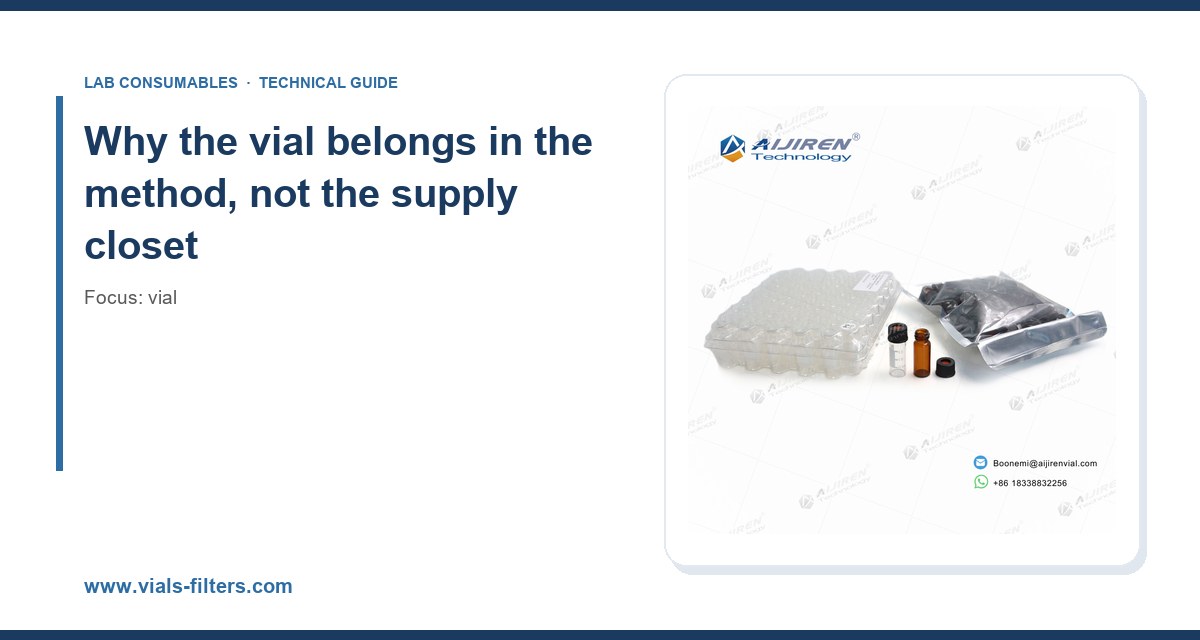
I have watched a validated EPA 8270 method fail an audit over a vial. Not the GC-MS, not the calibration curve, not the surrogate recoveries. The vial. The auditor pulled the raw data package, saw that the lab had switched from a 2 mL clear glass crimp vial to a screw-thread vial mid-quarter, and asked for the equivalency documentation. Nobody had written it. We spent three weeks reconstructing method equivalence evidence for a container change that cost us about four cents per sample. That experience reshaped how I think about vials in regulated work: the vial is part of the analytical method, not a consumable afterthought.
This article covers what that means in practice for labs running EPA SW-846, ISO methods, and AOAC protocols. It covers the specific dimensional, chemical, and documentation requirements that regulators actually check, and it gives you concrete selection criteria and a troubleshooting checklist you can hand to a new analyst.
Regulatory methods describe the sample container as part of the procedure. EPA Method 5030 (purge and purge-and-trap) specifies that samples be collected in 40 mL VOA vials with PTFE-lined septa and zero headspace. EPA Method 3510 (separatory funnel liquid-liquid extraction) requires the sample container be rinsed into the extraction vessel. AOAC methods routinely specify amber glass for light-sensitive analytes. ISO 5667-3, the water quality sampling standard, sets container and preservation requirements that national accreditation bodies audit against.
When you change vial suppliers, septum material, or closure type, you have changed a controlled parameter. Under ISO/IEC 17025:2017 clause 7.2.1, the lab must validate that the change does not affect method performance. Under EPA’s data quality requirements in SW-846 Chapter One, the change must be documented in the quality assurance project plan (QAPP). Most labs do neither, then discover the gap during an audit.
The practical fix is to treat the vial as a specified reagent. Write the part number, the glass type, the septum material, and the closure torque into the standard operating procedure. Then qualify a backup supplier before you need one. I keep a qualified-supplier list for vials that mirrors the list I keep for solvents and standards.
EPA SW-846: the methods that name the container
SW-846 is EPA’s compendium of test methods for solid waste. It is not a single regulation but a set of methods that states adopt, often with modifications. The full method set is published at the EPA SW-846 test methods page. Several methods in it specify vial geometry or closure type directly.
Method 5030 and 5035: the 40 mL VOA vial
Method 5030 (purge-and-trap for aqueous samples) requires a 40 mL VOA vial with a PTFE-faced silicone septum and a screw cap that seals without headspace. Method 5035 (closed-system purge-and-trap for solids) extends this to soil and requires the sample be preserved in the field, typically in a pre-weighed 40 mL vial with a stir bar and a preservative solution.
The critical dimensions are not negotiable. A 40 mL VOA vial has a nominal outside diameter of 27.5 mm and a height of about 95 mm, with a 24-414 thread finish. The 24 mm thread diameter and 414 finish (a specific thread profile defined by the Glass Packaging Institute) matter because the cap must seal at the same compression as the method’s original validation. A cap that torques to a different value changes the headspace pressure and, in closed-system methods, the mass of analyte that partitions into the headspace.
I have seen labs substitute a 20 mL headspace vial for a 40 mL VOA vial in Method 5030 because the smaller vial fit their autosampler tray. That is a method modification. It changes the phase ratio, which changes the purge efficiency, which changes the calibration. If you are going to do it, you validate it. For labs running dedicated headspace work, the correct container is a purpose-built headspace vial matched to the autosampler, not a repurposed VOA vial.
Method 8260 and 8270: the injection vial
Methods 8260 (volatile organics by GC-MS) and 8270 (semivolatile organics by GC-MS) do not specify the autosampler vial, but they specify the sample preparation, and the vial must not introduce contamination or adsorption. For 8270, the concern is adsorption of high-molecular-weight semivolatiles onto active glass surfaces. For 8260, the concern is volatilization loss and septum bleed.
Both methods are audited against the initial and continuing calibration criteria in the method, and a vial that contributes siloxane peaks or phthalate contamination will show up as failing calibration or as false positives. The fix is a low-bleed septum and a deactivated glass surface. I specify a silicone/PTFE septum for 8260 and a PTFE/silicone for 8270, both with a 0.010 in (0.25 mm) PTFE facing on the sample side. Anything thinner and the silicone can be punctured through during multiple injections.
ISO methods: container control is audited
ISO methods treat the sample container as a controlled item under the laboratory’s quality system. ISO 5667-3 (water quality, sampling, preservation and handling of samples) sets requirements for container material, cleaning, and holding time. ISO 17025 clause 6.3 requires that facilities and environmental conditions, including containers, not adversely affect validity of results.
For ISO 11885 (ICP-OES determination of elements in water), the container must be acid-washed and must not leach the analytes being measured. Borosilicate glass leaches boron and sodium. For trace boron work, use PTFE or high-density polyethylene. For trace mercury, glass with a PTFE-lined cap is acceptable but the holding time is 28 days and the container must be filled to eliminate headspace.
ISO 9308 and microbiology: the sterilized container
ISO 9308-1 (E. coli and coliform detection) requires the sample container be sterile and non-toxic to the organisms. That means the vial or bottle must be certified sterile, typically by autoclaving at 121 °C for 15 minutes, and must not contain residual detergent or mold-release agents. A glass vial that was rinsed but not properly depyrogenated will give false negatives. I have seen this in a municipal lab running 9308-1 on a new supplier’s bottles; the sodium thiosulfate preservative was fine, but the bottles had been washed with a phosphate detergent that left a residue toxic to coliforms. The fix was a certified sterile reagent bottle line with documented cleaning validation.
AOAC methods: the matrix matters
AOAC International methods for food and agricultural analysis often specify the container type and the closure, particularly for methods involving volatile analytes or light-sensitive vitamins. AOAC 2007.01 (pesticide residues in foods by QuEChERS) does not specify the vial, but the dispersive SPE step and the final extract container do affect recovery. A vial with an active glass surface will adsorb planar pesticides such as atrazine and chlorpyrifos.
For AOAC methods that involve headspace analysis of food volatiles, the vial geometry affects the phase ratio and the equilibration time. A 20 mL headspace vial with a 23 x 75 mm body and a 20 mm crimp or screw finish is the standard. The crimp version requires a specific crimping tool and a torque that seals without cracking the neck. I have a drawer of cracked vials from analysts who over-crimped. The correct crimp leaves the cap skirt flat against the vial shoulder with no visible deformation of the neck.
For GC work generally, the injection vial must be matched to the autosampler. Agilent and Thermo autosamplers have specific tray geometries and vial height requirements. A GC vial that is 0.5 mm too tall will jam the tray; one that is too short will not be picked up by the gripper. The standard 2 mL GC vial is 12 x 32 mm with a 11 mm crimp or screw finish. The 11 mm crimp requires a specific seal, and the screw version requires a 9 mm thread for the short-thread version or an 11 mm thread for the wide-mouth version. Mixing these up is a common source of autosampler errors.
Selection criteria with numbers
Here is the decision framework I use when specifying a vial for a regulated method. The numbers are from my own qualification work and from manufacturer specifications; verify against your method and your instrument.
Glass type and surface
- Type I borosilicate (USP Type I, ISO 3585): low alkali leaching, suitable for most HPLC and GC work. Thermal expansion coefficient about 3.3 x 10^-6 /°C. Use for pH-sensitive analytes and trace metals where sodium and boron are not targets.
- Type I deactivated glass: silanized or coated to reduce adsorption of polar and basic analytes. Use for semivolatiles, pesticides, and any method where recovery of a low-concentration polar compound is marginal. I specify deactivated for 8270 and for AOAC pesticide methods.
- Amber glass: required for light-sensitive analytes (vitamins, some pesticides, aflatoxins). Amber glass transmits less than 10% of light below 400 nm. Clear glass is not a substitute; a dark cabinet is not a validated substitute for amber glass in a method that specifies it.
- Polypropylene: for trace metals (especially boron, sodium, and silica), for fluoride, and for any analyte that adsorbs to glass. Not suitable for volatile organics because of permeability.
Septum and closure
- Silicone/PTFE: general purpose, good re-seal after puncture, suitable for multiple injections. Puncture count before leakage: 3 to 5 on a 0.010 in PTFE-faced septum. Replace after 5 injections if the method requires zero headspace or if the autosampler needle is large (22 gauge or larger).
- PTFE/silicone/PTFE (sandwich): lower bleed, better for trace analysis. Higher cost. Use for 8260 and for any method with a low detection limit.
- Butyl rubber: for headspace and for methods where silicone bleed interferes. Poor re-seal; single puncture only.
- Crimp vs screw: crimp gives a more reproducible seal and is preferred for headspace and for methods validated on crimp. Screw is easier to automate and re-open. Do not mix within a validation batch.
Closure torque
Torque matters more than most analysts realize. For a 24-414 screw cap on a 40 mL VOA vial, the target is 1.5 to 2.0 in-lb (0.17 to 0.23 N·m). Over-torque deforms the septum and creates a leak path; under-torque fails to compress the PTFE facing. I use a calibrated torque wrench for qualification and a fixed-torque capper for routine work. For 11 mm crimp GC vials, the crimp is set by the tool, not by torque, but the tool must be adjusted so the cap seats without cracking the neck. A cracked neck is a leaker and a source of glass shards in the autosampler.
Comparison checklist: vial selection by method
Use this table as a starting point. It reflects common configurations; confirm against your specific method text and instrument manual.
- EPA 5030 / 5035 (VOA, water and soil): 40 mL VOA vial, 27.5 mm OD x 95 mm, 24-414 screw finish, PTFE/silicone septum, zero headspace, torque 1.5 to 2.0 in-lb.
- EPA 8260 (volatile organics, GC-MS): 2 mL GC vial, 12 x 32 mm, 11 mm crimp or 9 mm screw, PTFE/silicone septum, low bleed. Replace septum after 3 to 5 injections.
- EPA 8270 (semivolatile organics, GC-MS): 2 mL deactivated glass vial, 12 x 32 mm, PTFE/silicone septum. Amber if the method or the analytes require it.
- ISO 11885 (trace metals, ICP-OES): 50 mL or 125 mL polypropylene or PTFE bottle, acid-washed, no glass for boron or sodium. Fill to eliminate headspace for mercury.
- ISO 9308-1 (microbiology): sterile glass or plastic bottle, 100 mL minimum, sodium thiosulfate preservative, certified sterile, no detergent residue.
- AOAC 2007.01 (pesticides, QuEChERS): 2 mL deactivated glass vial for final extract, 12 x 32 mm, PTFE/silicone septum. Amber for light-sensitive analytes.
- Headspace GC (generic): 20 mL headspace vial, 23 x 75 mm, 20 mm crimp or screw finish, butyl or PTFE/silicone septum, crimp tool adjusted to seat without cracking.
Operational precautions that prevent failures
The failures I see most often are not exotic. They are procedural.
Cleaning and handling
New glass vials are not clean enough for trace analysis. They carry manufacturing residues, including alkali from the glass forming process and mold-release agents from the cap. For trace metals and for methods with low detection limits, pre-clean with nitric acid (trace metal grade) at 10% v/v for at least 4 hours, then rinse with reagent water. For organics, rinse with the extraction solvent and dry. Do not use a laboratory detergent on vials destined for microbiology or for trace organics; the residue is hard to remove and is a known interferent.
Handle vials by the cap, not the body. Fingerprints on the glass are a source of sodium, chloride, and organic contamination. I require nitrile gloves and cap handling for all trace work, and I have caught analysts handling the body of a 40 mL VOA vial with bare hands. That is a contamination event.
Storage and holding time
The vial is part of the holding time. A sample in a 40 mL VOA vial with zero headspace holds volatile analytes for 14 days if preserved and stored at 4 °C per Method 5030. A sample with headspace loses volatiles within hours. The vial must be filled to the shoulder and capped without bubbles. I have seen a lab lose an entire batch of 8260 samples because the analyst left a 3 mm headspace bubble in each vial. The calibration was fine; the samples were not.
Autosampler compatibility
Check the vial against the autosampler tray before you buy a case. The 2 mL vial is standard, but the tray height, the gripper reach, and the needle depth vary by instrument. Agilent and Thermo publish compatibility tables in their consumables catalogs, and the Agilent chromatography consumables and Thermo Fisher chromatography and sample handling pages are the place to start. Restek also publishes vial and septum compatibility data and technical notes on bleed and adsorption at Restek technical resources.
Troubleshooting checklist
When a regulated method fails and the instrument is not the cause, work through this list before you re-run the batch.
- Check the septum puncture count. More than 5 punctures on a 0.010 in PTFE/silicone septum is a leak risk. Replace the septum and re-run the standard.
- Check the torque on screw caps. 1.5 to 2.0 in-lb for 24-414. Under-torque is a leak; over-torque deforms the septum. Verify with a torque wrench on a sample of caps.
- Check for headspace in VOA vials. Invert the vial and look for a bubble. Any bubble larger than 2 to 3 mm means the sample is compromised for volatile analytes.
- Check the glass surface for adsorption. If recovery of a polar or basic analyte is low and the calibration is good, switch to a deactivated vial and re-run the matrix spike.
- Check for septum bleed. Siloxane peaks at m/z 73, 147, 207, and 281 in the blank point to the septum. Switch to a PTFE/silicone/PTFE sandwich or a butyl septum.
- Check for phthalate contamination. Peaks at m/z 149 in the blank point to the cap or the vial. Phthalates come from plasticizers in the cap liner and from laboratory gloves. Switch to a PTFE-faced septum and nitrile gloves.
- Check the crimp. A cracked neck or a cap that spins freely is a leaker. Adjust the crimping tool and discard the vial.
- Check the cleaning residue. False negatives in microbiology or low recovery in trace metals point to detergent or acid residue. Re-clean and re-qualify the lot.
- Check the lot. If a new case of vials correlates with a new failure, quarantine the lot and run a qualification batch against a known-good lot before you use it in a regulated run.
Recommendation
For a lab running EPA SW-846, ISO, and AOAC methods, I recommend a two-tier vial program. Tier one is the qualified primary supplier: a 40 mL VOA vial with a 24-414 finish and a PTFE/silicone septum for 5030 and 5035, a 2 mL deactivated glass GC vial with an 11 mm crimp and a PTFE/silicone septum for 8260 and 8270, and a 20 mL headspace vial with a butyl septum for headspace work. Tier two is a qualified backup supplier with the same specifications, qualified by a side-by-side recovery and blank comparison before you need it.
Write the specifications into the SOP: glass type, dimensions, finish, septum material and thickness, torque, and puncture count. Qualify each lot with a blank and a matrix spike before it enters a regulated run. Keep the qualification records with the method validation package. The cost is a few hours per lot; the cost of an audit finding is weeks of reconstruction and a possible data invalidation.
The vial is a controlled parameter in a regulated method. Treat it like one and the method holds. Treat it as a commodity and you will eventually explain to an auditor why a four-cent part invalidated a quarter of data.
References & further reading
Related resources from our lab consumables network:
- Vial at vials-filters.com
- Headspace Vial at headspacevialsupplier.com
- Gc Vial at gcvialfactory.com
- Reagent Bottle at reagentbottleforsale.com
External references and standards: