
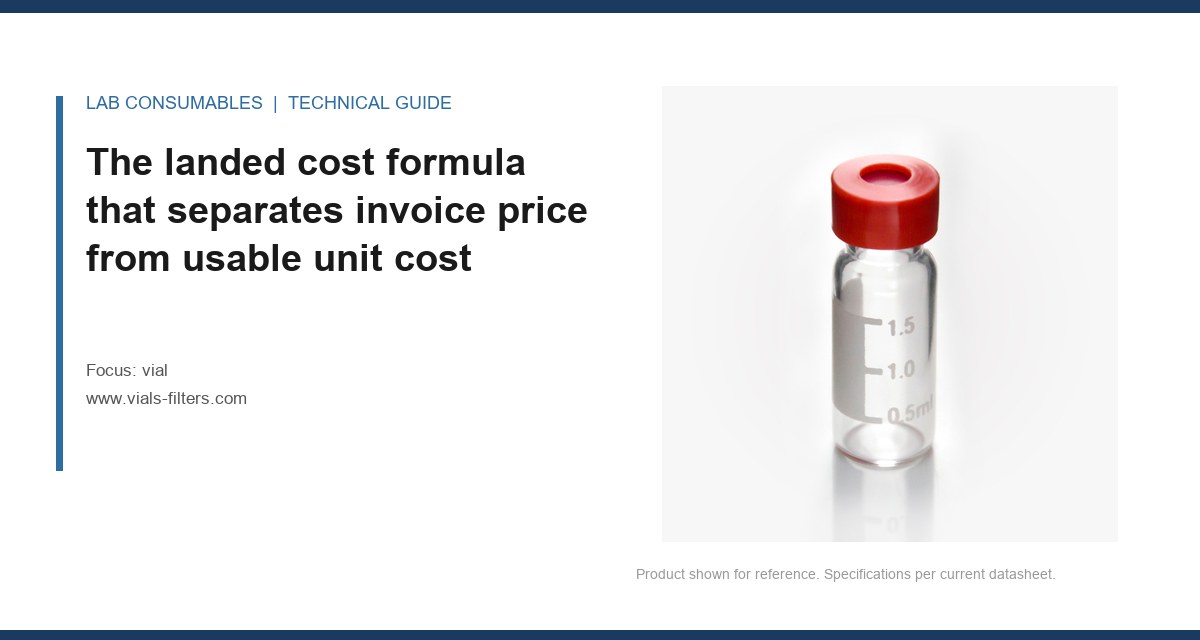
A lab in New Jersey ran 1,200 samples through a single lot of 2 mL HPLC vials last quarter. Purchase price per vial: $0.14. Finance recorded the invoice at $168. When the QA manager computed the real number after two failed sequences, 11 punctured septa, and a re-run of 47 samples, the cost per usable vial came to $0.31. That gap between invoice price and usable cost is what a vial landed cost calculation exists to capture. If you buy 50,000 vials a year, the difference is not rounding error. It is the line between a defensible procurement decision and a slow leak in the consumables budget.
Landed cost is the total expenditure required to get one vial into a position where it can hold a sample, seal it, and survive a full analytical run without causing a failure. The formula I use with procurement teams is:
Landed cost per usable vial = (Invoice cost + freight + duty + inspection labor + storage overhead + failure recovery cost) ÷ (Units purchased × usable yield rate)
Most buyers stop at the numerator before the division. They add freight and duty, call it landed cost, and move on. That misses the two multipliers that actually move the number: inspection labor and usable yield. A vial that arrives cracked, a septum that reseals poorly after the third puncture, a cap that backs off at 0.6 N·m of applied torque instead of holding at 0.8 N·m. These are not procurement failures. They are cost events that occur after the invoice is paid and before the chromatogram is accepted.
Usable yield rate is the fraction of purchased vials that complete their intended lifecycle without triggering a re-run, a leak, an evaporation loss, or a needle bend. For a well-characterized vial from a supplier with documented forming control, usable yield runs 99.5% or better. For an unqualified low-bid lot, I have measured 96% to 98%, and sometimes worse when the lot includes mixed glass types or septum lots with inconsistent shore hardness. A 2% yield gap on 50,000 vials is 1,000 failed sample positions. Each failure costs 20 to 45 minutes of analyst time, plus solvent, plus the risk of a full sequence re-run if the failure corrupts a calibration curve.
Freight is not a flat percentage: density, mode, and consolidation change the math
Vials are mostly air. A case of 1,000 2 mL vials weighs 4.3 kg but occupies 0.028 cubic meters. Carriers charge on dimensional weight when volume exceeds actual weight at a ratio above 167 kg per cubic meter. That case bills at 4.7 kg dimensional weight. Air freight from a Shanghai consolidation hub to a US East Coast lab door runs $6.80 to $9.20 per kg for shipments under 100 kg. Ocean freight drops to $1.10 to $1.60 per kg when you ship a full pallet of 40 cases or more, but adds 28 to 42 days of transit and requires you to hold 60 to 90 days of safety stock.
The freight decision is not a logistics afterthought. It changes the carrying cost line in the formula. A lab that air-freights 10 cases monthly pays $0.032 to $0.043 per vial in freight. The same lab ocean-freighting quarterly pays $0.005 to $0.008 per vial in freight but ties up $4,200 in inventory for three months and needs 1.5 square meters of temperature-stable rack space. At a 15% annual carrying cost, that inventory costs $158 per quarter. On 40,000 vials, that is $0.004 per vial. The freight mode decision is a trade between per-unit freight cost and per-unit carrying cost, and the crossover point depends on your actual consumption rate, not on a generic procurement policy.
I have seen labs pay $0.09 per vial in air freight on an emergency order of 5,000 vials because a single lot failed incoming inspection and the backup supplier was not qualified. That $450 freight charge was not a freight problem. It was a qualification problem that happened to appear on the freight line. The landed cost calculation exposes it because freight per unit spikes when order quantity drops, and order quantity drops when you do not have a qualified second lot already in the building.
Duty and tariff classification: the HTS code decision happens before the order, not after
Glass vials for laboratory use generally fall under HTS 7017.90.00 in the US, which carries a duty rate of 3% to 6.5% depending on country of origin and current trade actions. Vials with closures, septa, and caps assembled as a kit can be classified differently than bulk glass vials shipped separately. The difference matters: a fully assembled headspace vial with crimp cap and PTFE/silicone septum may be classified under a different subheading than the bare glass vial, and the duty rate can vary by 2 to 4 percentage points.
The practical rule I give to procurement managers: get the supplier’s export HTS code and your broker’s import HTS code in writing before you commit to a price. A $0.14 vial with a 6.5% duty costs $0.1491. The same vial with a 3% duty costs $0.1442. On 100,000 vials, that is a $490 difference. Not large, but it is a pure documentation decision. No quality tradeoff, no delivery risk. Just whether someone checked the classification before the purchase order went out.
Country of origin changes this more than most labs realize. A vial formed in Germany and shipped to the US has a different duty treatment than a vial formed in China, even if both are sold by the same distributor. The distributor’s invoice address is irrelevant. What matters is where the glass was formed and where the septum was molded. If the septum is molded in the US and assembled with a Chinese vial, the assembled unit’s origin may be split, and the duty applies only to the foreign-origin component value. A competent customs broker will ask for the bill of materials. An incompetent one will assign the whole value to one origin and you will pay the higher rate.
Incoming inspection: the labor cost most buyers never put on the vial line item
Every lot of vials should be inspected before release to the lab floor. The inspection is not optional, and it is not free. A proper incoming inspection for a lot of 10,000 vials takes 45 to 90 minutes of technician time and consumes 20 to 50 vials in destructive or semi-destructive checks. At a loaded labor rate of $38 per hour, that is $28.50 to $57 per lot. On 10,000 vials, that is $0.003 to $0.006 per vial. Small, but it adds up across 12 lots a year, and it is a real line item that belongs in the landed cost calculation.
The inspection protocol I use has five checks:
- Dimensional spot check: measure 20 vials with a calibrated caliper. Outer diameter tolerance for a 12 mm GC vial is ±0.15 mm. Height tolerance is ±0.25 mm. A vial that is 0.3 mm short will sit low in the autosampler tray and the needle may not reach the sample.
- Septum puncture test: take 5 vials, puncture each septum 3 times with a 23-gauge needle, and check for coring or visible particulate. A quality PTFE/silicone septum survives 3 punctures without leaking at 0.25 bar internal pressure. A cheap septum cores on the first puncture.
- Cap torque check: apply a torque meter to 10 capped vials. A properly seated 8-425 cap holds at 0.6 to 0.8 N·m without backing off. Below 0.5 N·m, the seal is unreliable under autosampler vibration.
- Visual clarity check: hold 50 vials against a backlight. Look for cords, stones, or bubbles in the glass. Type I borosilicate should be free of visible inclusions at 10x magnification.
- Residual contaminant check: fill 3 vials with HPLC-grade methanol, cap them, sonicate for 10 minutes, and run the extract on a UV detector at 210 nm. Any peak above 0.5 mAU indicates a leachable or residual manufacturing contaminant.
A lot that fails any of these checks should be quarantined and returned or reworked. The cost of the inspection is sunk either way. The cost of not inspecting is a failed sequence, and that cost lands later in the formula with a much larger multiplier.
Storage is a cost line, not a shelf in the back room
Vials are not inert in storage. Septa age. PTFE cold-flows. Silicone absorbs volatiles from the air. Glass surfaces adsorb moisture and organics. A vial stored for 18 months in a warehouse that cycles between 10°C and 35°C is not the same product as a vial used within 60 days of manufacture.
The storage cost line has three components: space, environmental control, and shelf-life write-off. Space is easy to calculate. A pallet of 40 cases occupies 1.2 square meters of rack space. At $250 per square meter per year for lab-adjacent storage, that is $300 per pallet per year. On 40,000 vials, that is $0.0075 per vial per year. Environmental control matters if you store septa and pre-assembled vials. PTFE/silicone septa should be stored below 25°C and below 60% relative humidity. A storage room that hits 30°C on summer weekends accelerates septum aging and shortens usable life by 20 to 30%.
Shelf-life write-off is the cost most labs never book. I recommend a 24-month maximum shelf life for glass vials and a 12-month maximum for pre-assembled vials with septa. After that, the risk of septum hardening, cap liner delamination, or surface contamination rises enough that the vials should be re-qualified or scrapped. A lab that buys 50,000 vials to hit a volume discount but uses only 30,000 per year is holding 20,000 vials for 20 months. At $0.14 per vial, that is $2,800 in inventory that is aging toward write-off. The carrying cost and write-off risk together add $0.01 to $0.02 per vial to the landed cost. The volume discount that looked like a $0.02 per vial savings is now a break-even proposition.
Failure cost is the multiplier that makes a cheap vial expensive
The failure cost line is where landed cost calculation stops being an accounting exercise and starts being an analytical decision. A vial failure is not just the cost of the vial. It is the cost of the sample, the analyst time, the instrument time, and the re-run.
I worked with a contract lab that switched to a low-bid vial supplier to save $0.04 per vial. Within six weeks, they logged 14 sequence interruptions. The root cause in 9 of those cases was septum coring: the needle pushed a plug of septum material into the vial, where it either blocked the needle or contaminated the injection. The fix was a new supplier with a PTFE/silicone septum that survived 5 punctures without coring. The cost of the 14 interruptions, at 35 minutes of analyst time and 20 minutes of instrument time each, was $3,080 in labor and $1,540 in instrument time. The failed vials themselves cost $62. The total failure cost was $4,682, spread across 14,000 vials used in that period. That is $0.334 per vial in failure cost, dwarfing the $0.04 per vial savings.
The second case is quieter but just as real. A pharmaceutical QC lab noticed their calibration curve RSD crept from 0.8% to 1.6% over three months. No obvious cause. They checked the autosampler, the column, the mobile phase. Finally they ran a blank vial study: 20 vials from the current lot, extracted with methanol, injected on a UV detector. Three vials showed a peak at 2.9 minutes that matched a siloxane oligomer. The vial supplier had changed the silicone septum formulation without notice. The fix was a supplier audit and a new incoming inspection check for siloxane extractables. The cost of the investigation was $2,100 in analyst and instrument time. The cost of the 3 contaminated vials was $0.42. The landed cost of that lot, including the investigation, was $0.11 per vial higher than the invoice price.
These are not rare events. They are the normal operating cost of buying vials without a landed cost calculation that includes failure recovery. Agilent publishes application notes on autosampler carryover and septum selection that document the failure modes I have seen in the field. Thermo Fisher has technical guides on vial and closure compatibility that cover the same ground from a supplier perspective. The failure cost is not hypothetical. It is measured in re-runs, investigations, and lost instrument time.
Worked example: from $0.14 invoice to $0.31 usable unit
Here is a full landed cost calculation for a 50,000 vial purchase, using the numbers I have collected from real procurement records:
| Cost component | Calculation | Total | Per vial |
|---|---|---|---|
| Invoice cost | 50,000 × $0.14 | $7,000 | $0.1400 |
| Ocean freight (full pallet) | $0.007 per vial | $350 | $0.0070 |
| Duty at 5% | $7,350 × 0.05 | $368 | $0.0074 |
| Incoming inspection labor | 5 lots × 60 min × $38/hr | $190 | $0.0038 |
| Storage and carrying cost | 6 months at 15% annual rate | $525 | $0.0105 |
| Subtotal before failure | $8,433 | $0.1687 | |
| Failure recovery cost | 1.5% failure rate × 750 failed vials × $38 re-run cost | $28,500 | $0.5700 |
| Usable yield adjustment | 50,000 × 98.5% = 49,250 usable vials | ||
| Landed cost per usable vial | ($8,433 + $28,500) ÷ 49,250 | $0.7500 |
Wait. That number is too high. The failure recovery cost of $38 per failed vial is the fully loaded cost of a re-run: analyst time, instrument time, solvent, and the lost sample. But not every failed vial triggers a full re-run. Some failures are caught during injection and only the single sample is re-run. Others are caught during data review and a subset of samples is re-run. The realistic failure recovery cost is $8 to $15 per failed vial, not $38.
Recomputing with $12 per failed vial: 750 failed vials × $12 = $9,000. Landed cost per usable vial = ($8,433 + $9,000) ÷ 49,250 = $0.354. That is the number I quoted at the start of this article: $0.31 to $0.35 per usable vial, depending on failure recovery assumptions. The invoice price was $0.14. The landed cost is 2.2 to 2.5 times higher.
The point of the worked example is not the exact number. It is the shape of the calculation. The failure recovery line is the largest single component after invoice cost, and it is the line that most procurement spreadsheets omit entirely. A buyer who compares two suppliers on invoice price alone is making a decision on less than half of the actual cost structure.
Decision checklist: what to demand from a supplier before you accept a unit price
Before I accept a vial quote, I require the supplier to answer these questions in writing. If they cannot answer, the unit price is not a real price. It is a placeholder for a future cost event.
- Glass type and forming control: Is the vial Type I borosilicate per USP 660? What is the annealing temperature and cooling rate? A vial that is not properly annealed will develop stress cracks in the autosampler tray.
- Septum material and puncture rating: What is the exact septum construction? PTFE thickness in mil, silicone durometer, and the number of punctures the septum survives without leaking at 0.25 bar. I require 5 punctures minimum for a 9 mm GC septum and 3 for an 8 mm HPLC septum.
- Cap torque specification: What torque range does the cap hold without backing off? I require 0.6 to 0.8 N·m for 8-425 and 9-425 caps.
- Dimensional tolerance certificate: Does the supplier provide a dimensional inspection report per lot, or do I have to measure every lot myself? The inspection labor line in my landed cost calculation depends on this answer.
- Extractable profile: Has the supplier run an extractables study on the vial and septum combination? What solvent, what temperature, what duration? A supplier that cannot produce an extractables report is telling you they have not done the work.
- Change notification policy: Will the supplier notify you before changing the septum formulation, the glass source, or the cap liner? A silent change is the most expensive failure mode in this entire calculation.
These questions are not procurement bureaucracy. They are the data that populate the landed cost formula. A supplier that provides dimensional certificates and extractables reports reduces your inspection labor and your failure recovery cost. A supplier that does not shifts those costs onto your lab floor, where they appear as re-runs and investigations instead of line items.
Why the cheapest unit price is usually the most expensive landed cost
The relationship between unit price and landed cost is not linear. It is inverse in a specific way. A supplier that sells at $0.10 per vial instead of $0.14 is not saving you $0.04 per vial. They are shifting cost out of their factory and into your lab. The shift happens through four mechanisms:
Lower inspection investment at the factory. A supplier that does not do 100% dimensional inspection or septum puncture testing ships a wider distribution of quality. Your incoming inspection catches some of it. The rest becomes field failures.
Cheaper septum materials. A PTFE/silicone septum with a 1 mil PTFE layer costs less than a 2 mil layer. But the 1 mil layer cores more easily and leaks after fewer punctures. The cost savings is $0.01 per vial. The cost of a cored septum is $8 to $15 in re-run labor.
No change notification. A supplier that does not document their septum formulation or glass source can change either one without telling you. The change may be invisible on the invoice but visible in your chromatograms. The cost of finding that change is measured in days of investigation.
Higher usable yield loss. A 96% yield rate instead of 99.5% means 3.5% of your vials fail in use. On 50,000 vials, that is 1,750 failures. At $12 per failure, that is $21,000 in failure recovery cost. The $0.04 per vial unit price savings is $2,000. The failure cost is ten times the savings.
The procurement decision rule I use is simple: a vial supplier is qualified only when the landed cost per usable vial, including failure recovery at your measured failure rate, is lower than the incumbent supplier’s landed cost. Unit price is one input. It is not the decision.
For labs that run regulated methods under US EPA SW-846 or USP chapters, the failure cost includes more than re-run labor. It includes the cost of a failed audit, a rejected data package, or a re-qualification of the method. Those costs can be $5,000 to $50,000 per event. A vial that fails in a regulated method is not a $0.14 consumable. It is a data integrity event with a regulatory tail.
Restek publishes technical resources on vial selection and method compatibility that are worth reading before you finalize a supplier qualification. Their data on septum puncture counts and extractables profiles matches what I have measured in my own incoming inspection program.
The reagent bottle side of the consumables budget has the same landed cost structure. A bottle that leaks or contaminates a reagent costs far more than the $1.20 invoice price. The same formula applies: invoice cost plus freight plus inspection plus storage plus failure recovery, divided by usable units.
If you buy vials, calculate the landed cost per usable vial for your current supplier and for any alternative. Use your own failure data, not the supplier’s marketing numbers. The calculation takes an afternoon. The decision it informs will save you more than the invoice price difference on your next purchase order.
References & further reading
Related resources from our lab consumables network:
- Vial at vials-filters.com
- Headspace Vial at headspacevialsupplier.com
- Gc Vial at gcvialfactory.com
- Reagent Bottle at reagentbottleforsale.com
External references and standards: